Stop Lidl Lewes
“It is not a field of a few acres of ground, but a cause, that we are defending, and whether we defeat the enemy in one battle, or by degrees, the consequences will be the same.” Thomas Paine
August 2026
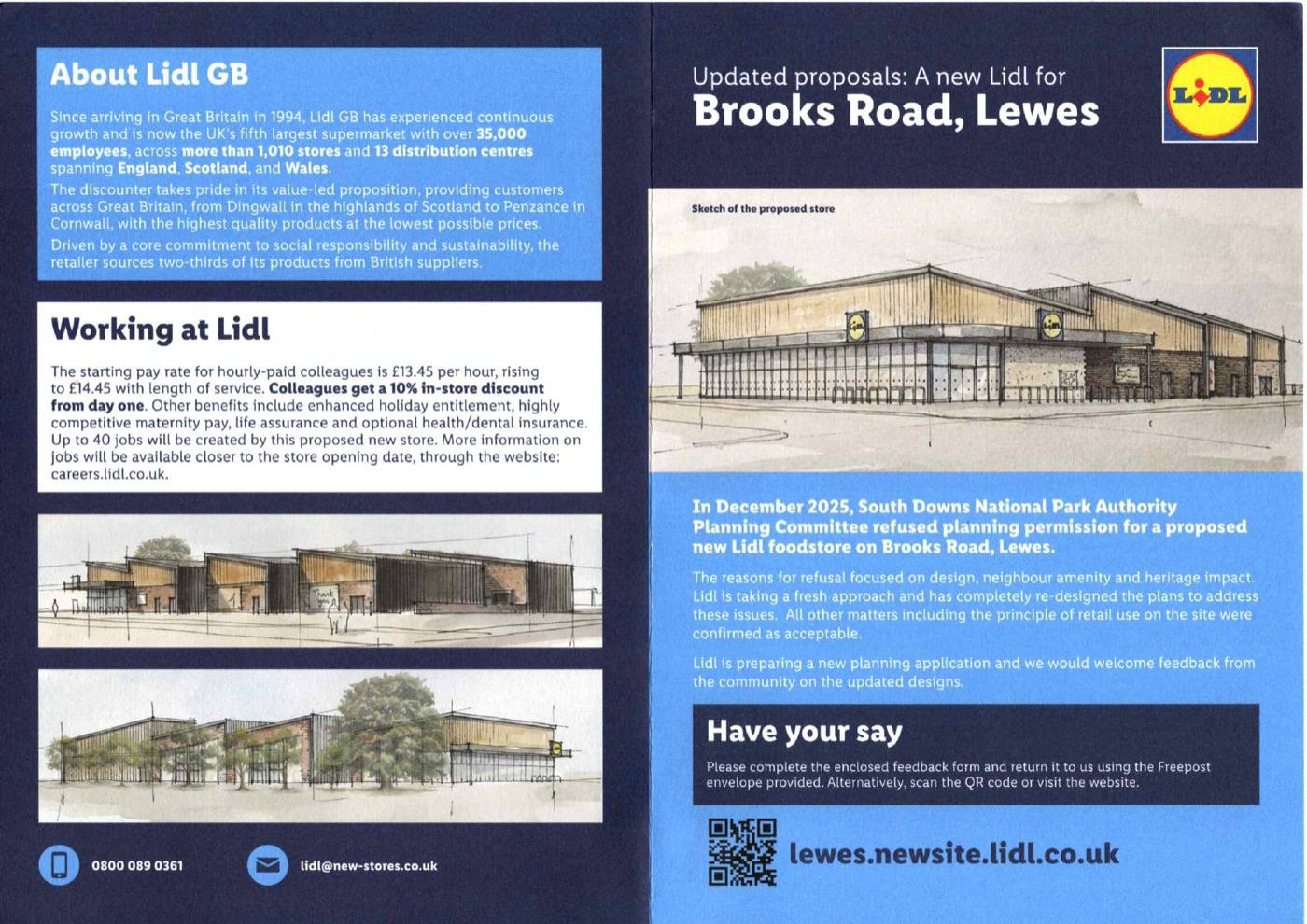
Lidl have posted flyers to the majority of Lewes residents giving a preview of their plans for the Brooks Road site. A scan of the flyer can be seen below.
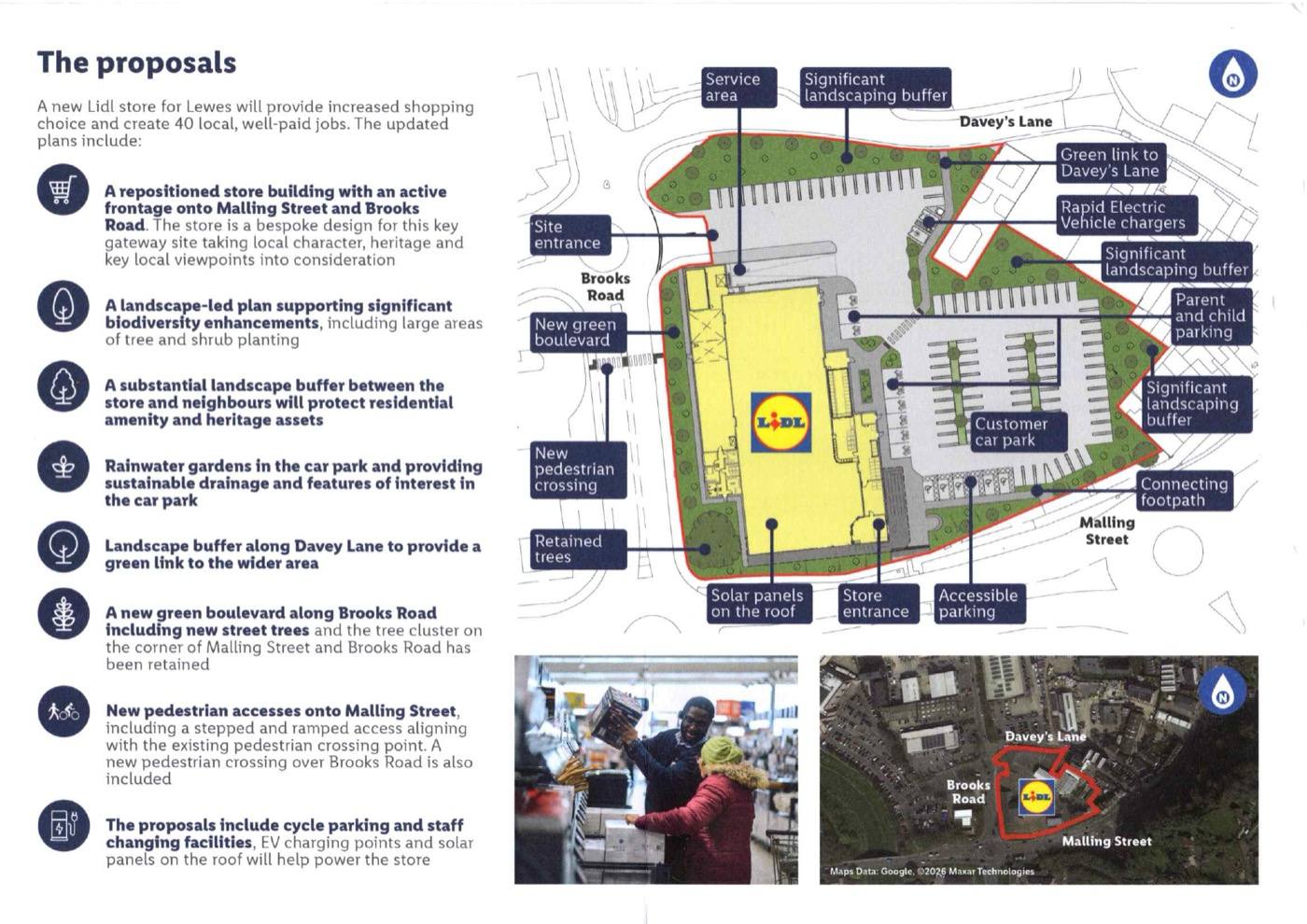
The inside of the leaflet shows a high-level, and preliminary plan for the proposal.
Current state
There are significant changes from the previous scheme. The store building has been repositioned and the site layout extensively redesigned, and the plans show new pedestrian connections into the site, including what Lidl label a “connecting footpath” from Malling Street. However, it is important not to read more into these preliminary plans than they actually tell us.
There are aspects of the redesign which appear to address criticisms of the previous application, and we should acknowledge improvements where they have genuinely been made. There are also important things we simply cannot assess yet.
A preliminary site plan cannot tell us, for example, exactly how the boundaries adjoining neighbouring properties will be treated; where plant and other equipment will be positioned; what the noise implications will be; what landscaping and screening will actually consist of; or all the detailed consequences for traffic, pedestrians, heritage, employment land and neighbouring amenity.
The leaflet states that, apart from design, neighbour amenity and heritage, “all other matters including the principle of retail use on the site were confirmed as acceptable”. That is Lidl's characterisation of the December 2025 refusal. It is important to understand that any new application is determined afresh, on its own evidence and against the policies applying at the time it is being assessed.
We therefore don't think it is useful to undertake significant detailed analysis before seeing the actual planning application and its supporting documents.
Lidl's "consultation"
Lidl have invited people to comment directly to them on their proposals. People are, of course, entirely free to do that, and Lidl may take those comments into account before submitting its application.
However, responding to Lidl’s consultation is not the same thing as making a representation on a planning application. Comments sent directly to Lidl are comments to the developer, not representations to the planning authority. The important opportunity to comment from a planning perspective comes after Lidl submits its planning application, when the South Downs National Park Authority carries out the statutory consultation on the application.
So, if you want your views to be considered when the planning application is determined, you will need to submit them to the planning authority once the application is open for public comment.
Right of Way
Since Lidl's previous planning application, East Sussex County Council has made Definitive Map Modification Order RWO 330, following an application to record the public footpath across the site on the Definitive Map. This is an important development, but the process is not finished. The Order has been made, but it has not yet been confirmed. If objections are made and not withdrawn, the Order cannot simply be confirmed by the Council and will have to proceed through a statutory process involving the Planning Inspectorate, which can take many months.
From the preliminary material available to us, the pedestrian route shown in Lidl's new design does not appear to follow the alignment of RWO 330. It is also worth noting that neither the letter nor the leaflet mentions the Order, or a public right of way, at all. We also do not yet know Lidl's legal position on RWO 330. Lidl can design a scheme which makes some allowance for a possible right of way while still objecting to the Order and denying that the public right exists.
Equally, providing an alternative pedestrian route on a planning drawing does not itself move or extinguish a public right of way. If RWO 330 is ultimately confirmed on its present alignment, changing or extinguishing that right would require a separate legal process.
Please see the Right of Way page for more details.
What happens next?
For the moment, our approach is simple: wait for the actual application. Once it is submitted, we will make an assessment. In particular:
- the precise treatment of RWO 330 and the pedestrian route;
- The relationship between the development and neighbouring properties;
- Plant, noise and other amenity impacts;
- traffic and pedestrian safety;
- heritage and design;
- employment-land issues and the justification for the development; and
- Lidl's account of the consultation it has undertaken before submission.
We will then circulate another update explaining what has actually been submitted, what appears to have improved, what concerns remain, and how and when people can make effective representations to the planning authority.
There are therefore two separate statutory processes running alongside one another: the planning application and the RWO 330 rights-of-way process. Neither should be confused with Lidl's own pre-application consultation.
For now, the most important point is that we have seen a preliminary proposal, not the complete planning application. There is useful information in it, but there is still a great deal that we do not know.
Stay informed
- Join our mailing list – get an update when the new planning application is submitted.
- Tell interested neighbours – make sure people understand that the preliminary plans are not yet the submitted planning application.
- Wait for the formal consultation – once the application is submitted, we will publish details of how to make an effective representation to the planning authority.
We will update this site when the full planning application and supporting documents are available.